
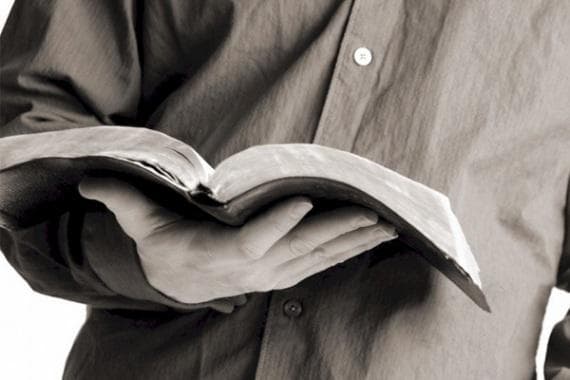
The word of the hour is faithfulness and our objective is to perfect the saints in the cultivation of faithfulness. But we know that an important part of this will only happen because we have faithful pastors. It is legitimate to affirm that to have faithful churches we need faithful pastors. When a church goes off the rails, it is usually because its pastor has already left before. But what is a faithful pastor? In these times of so much denominational, theological and methodological variety (and so much personalistic leadership), it is possible to draw profiles divergent from what a faithful pastor would be. For this reason, it is necessary to return again to the Bible and let it speak for itself, allow it to be a unique parameter for this definition. As the prophet Isaiah says: “To the Law and to the Testimony!” (Is.8:20). Let us go to the Bible, then!
When the risen Jesus asked Peter, three times, if he “loved” him, to each of his responses he replied with the following recommendation: “Shepherd my sheep” (Jo.21:15-17). Despite the contempt that the Pharisaic rabbis dedicated to the profession of shepherd, which was always suspected of dishonesty and was not even accepted as a witness in a trial, this was the figure Jesus used to hold Peter responsible for the care of his disciples after his ascension, as well as to speak of God's love for sinners (Lc.15:1-7) and also to speak of himself as responsible for his sheep (João 10). The function of the shepherd in the lands of Palestine required patience, caution and honesty. In the dry summer, on weak land, it was not easy to find new pastures and sufficient water. It was very difficult to achieve the correct balance between feeding, water supply, rest and travel.
The shepherd had to tirelessly care for the defenseless animals (Ez. 34:1-31). His dedication was put to the test when he had to guard the flock, night after night, against wild animals and robbers (João 10:12).
The titles effectively used in the New Testament for the main leader of the local church were “presbyter” (or “elder”) and “bishop”. Only in Ef.4:11 do we find the mention of “pastors”. But when the biblical authors wanted to speak of the function of this leader, they used the verb “to shepherd”, as Paul does in At.20:28-31, speaking to the presbyters of Ephesus: “Keep watch over yourselves and all the flock of which the Holy Spirit has made you overseers. Be shepherds of the church of God, which he bought with his own blood. I know that after I leave, savage wolves will come in among you and will not spare the flock. Even from your own number men will arise and distort the truth in order to draw away disciples after them. So be on your guard! Remember that for three years I never stopped warning each of you night and day with tears”. And as Peter does in I Pd.5:1-3: “To the elders among you, I appeal as a fellow elder and a witness of Christ's sufferings who also will share in the glory to be revealed: Be shepherds of God's flock that is under your care, watching over them—not because you must, but because you are willing, as God wants you to be; not pursuing dishonest gain, but eager to serve; not lording it over those entrusted to you, but being examples to the flock”.
A few years ago a relative of mine, having gone to her church on a Sunday, was greeted by the pastor in the following way: “Thank you very much for your visit. Come back always”. To which she replied: “But I am not a visitor, I have been a member of this church for many years. Actually, I am the former pastor's daughter-in-law”. What impressed me most in the book “The Purpose Driven Church” (Ed. Vida, SP, 7th Print, 2002), by Rick Warren, one of the most praised (and also most emulated) evangelical leaders of today, was his statement that a pastor cannot care for more than two hundred sheep, a statement that is in blatant contradiction with the rest of the book (when I reached this part - p. 125 - I almost abandoned reading). He is right and this observation is not only his. Other scholars of pastoral work have already said the same thing. I doubt that any pastor in sound mind and with a pure soul can say otherwise.
In fact, at least for me, this number is even smaller. When I began my ministry I established that I wanted to be a pastor like Jesus: I wanted to know my sheep and be known by them (Jo.10:14). This means, at the very least, knowing the name, address, age, profession, illnesses, gifts, names of children, ideas, lifestyle, etc., of each one of the sheep. It also means interacting with them personally, not just through the pulpit, or the telephone, but also through visitation and sharing in happy and sad times. I have been pastor of six churches over thirty-eight years, none of them with more than one hundred members. Obviously, I had and have my personal limitations and I do not want to compare myself to other pastors, but I came to the conclusion that to be faithful to the biblical standard I could not be a pastor any other way.
Not long ago I received a letter from a “megachurch”, inviting me to an event that would be led by several of its pastors. I was impressed with the quantity and diversity of pastors and their functions. There were pastors of all kinds, but there was not a single “pastor” pastor, that is, a pastor of sheep.
I understand that to be a faithful pastor, the first thing to do is, simply, to “shepherd”. And to shepherd is to encourage each one, from house to house, night and day, if necessary with tears; it is to work and give example; it is to help those in need; it is to give more than to receive; it is to serve with humility (At 20:17-38). To shepherd is to feed and shelter the sheep, defend them and even give your life for them (Jo.10). To shepherd is to seek the lost sheep, free them from dangers and enemies, heal their wounds (Lc.15:1-7). To shepherd is to love as God loves, to be content with enough for your sustenance, not to tyrannize the flock, to be a model to be followed by the flock (I Pd.5:1-9 and I Tm.6:8). If we are not doing this, we are not being faithful pastors.
A faithful pastor is one who handles the Word of God well (II Tm.2:15), holding it firm and faithfully, so that he is powerful both to teach those who want to learn and to convince those who contradict and to silence the insubordinate and deceivers (Tt.1:9-11). It is one who preaches the Word with integrity, whether the listeners find it convenient or not, whether they want to hear or feel an itching in their ears (II Tm.4:2-4), never shying away from proclaiming all God's counsel (At.20:27), so that they know that a prophet was among them (Ez.2:1-10). It is one who does not manipulate the Bible, using it to justify his personal visions (Jr.23:25-28), nor falsifies or adulterates it to satisfy vanities or personal interests (II Co.2:17 and 4:2).
A faithful pastor is one who watches over the sheep, as one who will give account of them to the Lord who entrusted them to his hands (Hb.13:17 and I Pd.5:3). It is one who feels daily the weight of concern for the problems that afflict the sheep (II Co.11:28-29). It is one who suffers with the tribulations that fall upon them (I Ts.3:1-8). It is one who intercedes day and night for the sheep, exercising this priestly facet of pastoral ministry (Jo.17:1-26; Ef.1:15-23; Fp.1:3-11; Cl.1:9; I Ts.1:2,3;2:13;3:9-13).
A faithful pastor must live an irreproachable life as a human being, husband, father and Christian, so that he can lead the church with integrity (I Tm.3:1-7). Finally, he will place the ministry above his own life (At.20:24); he will fulfill his mission without expecting glory or human recognition, in the certainty that he in whom he believed, and who called him to be a pastor, will be sufficient and powerful to keep his treasure until the final day (II Tm.1:12), and that this Supreme Pastor will manifest himself on that day and will give him the unfading crown of glory (I Pd.5:4 and II Tm.4:6-8).
Pr. Sylvio Macri - Igreja Batista Central de Oswaldo Cruz