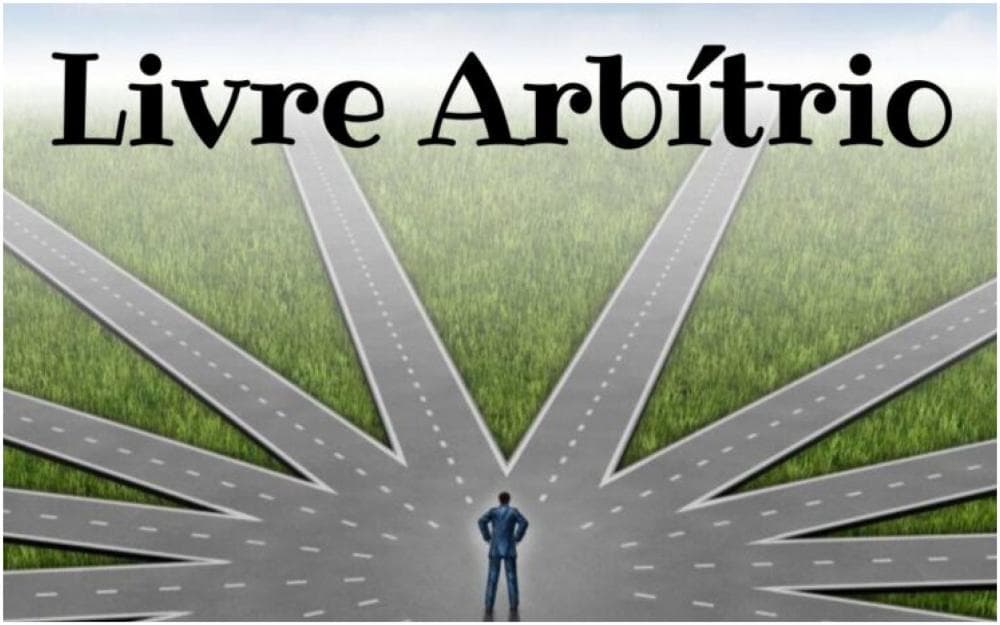
Who has never heard someone say: "I can do whatever I want, because I have free will", or else the statement: "it is free will that determines your future"?
In this study we will try to explain in a simplified way what it is, what its importance is, and how far free will goes, as well as how much the consequences can be impactful, although many times the choice may seem simple.
Meaning:
Free will is the power that each individual has to choose their actions, which path they want to follow. The expression is used by various religions, as a way to guide individuals so that they always have responsible attitudes.
The real meaning of free will has religious, psychological, moral and scientific meanings. For some people free will means having freedom, and often some get lost in the face of multiple choices.
Complement:
Each one really has the right to do whatever they want with their life, and choose which path they want to follow, however it is important that you are certain of the consequences that each choice may bring.
The expression "free will" is not in the Bible, however, in various passages we can see that God gives human beings the power to choose.
According to the Bible, God's will is for people to follow His commandments and do good things. It is also possible to see in the Bible that each person will give an account of how they use free will, that is, each one will be held responsible for their actions, in short for everything they did during the time they lived in this only life that is granted to all.
The Bible also speaks of predestination, where some people are chosen even before they are born, and are predestined to follow God's path.
For some people this is a conflict, because they say that if a person was predestined to do something, they have no will of their own. Despite this, the Bible says that despite having chosen some people, this does not interfere with their free will, the person's choice is free, but God knows beforehand what the person will choose.
In some beliefs there is the simple thought that the acts practiced were not predetermined, and therefore each person is responsible for their choices. Thus, free will is developed together with the development of intelligence and implies an increase in the accountability of acts practiced.
In the realm of philosophy, free will opposes determinism, which holds that all events are caused by previous facts. For determinism, human actions are determined by laws of nature or other causes and therefore the human being cannot be held responsible for their actions. For philosophy, the individual does exactly what they had to do, their actions are inherent to their will, and occur with the force of other causes, internal or external.
What is its importance in our lives:
Based on the statements: "For each choice, a renunciation" and "it is free will that determines your future", we see the great importance of truly understanding what it is, and how it can be applied in our lives.
Although presented as a source of information, we will disregard here most of the philosophical view of free will, since it clashes with the convictions of the Bible, which points out that each individual is responsible for their actions, it is not for nothing that it is written in Ezekiel 18:3-9: "As I live, says the Lord GOD, you shall no more use this proverb in Israel. Behold, all souls are mine; as the soul of the father, so also the soul of the son is mine: the soul that sins, it shall die. Being, therefore, a righteous man, and practicing judgment and justice, Not eating on the mountains, nor lifting up his eyes to the idols of the house of Israel, nor defiling his neighbor's wife, nor coming to his wife in her separation, Not oppressing anyone, restoring to the debtor his pledge, not stealing, giving his bread to the hungry, and covering the naked with clothing, Not giving his money to usury, and not receiving excessive interest, withdrawing his hand from injustice, and doing true judgment between man and man; Walking in my statutes, and keeping my judgments, and proceeding according to the truth, such a righteous man shall surely live, says the Lord GOD.".
In short, free will exists so that we understand that we are not robots programmed to say amen, as some say, but rather people with wills and power of decision of our own, and therein lies the importance of knowing how to use it, because in each decision made we always choose something and give up another.
Free will deals with firm choices, that is, it is not considered a firm choice when the person wants to divide themselves in more than one possibility, which would certainly make the result of such a position unsustainable, I will exemplify: The person wants to marry and live a single life, the person wants to have a job but not be dedicated, and it can still be worse, in the case when the person thinks they serve God, but does not disconnect from sin, and remains in the worldly life away from their doctrines.
How far free will goes:
Knowing that free will is the power of choice, the freedom to make the decision, we can then affirm that it is only worth up to the moment of choice, that is, once decided, the freedom permitted by it has already been applied, having given it up by the decision made.
A person cannot, for example, choose both options such as: marry and remain single, get up and stay sitting, eat and not eat, work and remain idle, Serve God and live without obeying him.
Let us exemplify further below, with some possibilities of choice and their consequences.

Click here to View the Image in detail
Considerations:
From the table presented above, it can be observed that many times the decision to be made would be something relatively simple, however the resulting consequences are immeasurable, since the decision would be like sowing a seed, in short like planting something, while the consequences are like the harvest obtained from what was sown. That is why it is very important to make good use of the freedom that is granted to us, and to be sure that a choice automatically cancels the possibility of opting for the other alternative.
In the Bible we have the instruction that we should be guided by taking Yes or No as a basis, that is, whether or not we are firm in some position, that is, certain of the decision made.
We know that many doubts regarding decisions about this life is what is most before all of us, however there is also a Biblical suggestion for these questions, which is described with the following statement In the Book of Matthew, chapter 6, from verse 31 to 34, Jesus gives the following instruction to his disciples: "Therefore do not be anxious, saying, What shall we eat? or, What shall we drink? or, With what shall we be clothed? For after all these things do the Gentiles seek. For your heavenly Father knows that you need all these things; But seek first the kingdom of God, and his righteousness; and all these things shall be added unto you. Take therefore no thought for the morrow: for the morrow shall take thought for the things of itself. Sufficient unto the day is the evil thereof."
We have another study regarding what it means to "Seek first the Kingdom of God", and needless to say, it has nothing to do with stopping working to live within congregations, or in some place only reading the Bible, praying on some mountain 24 hours a day, or doing only such things.
Click here and read: "seek first the kingdom of God, and his righteousness...", how to understand?
Conclusion:
Free will is always present in our lives, and it is up to us to make the best decision, and as stated, the best decision is always made when guided by God, that is, when we have commitment to the one who is Wonderful, Counselor, Mighty God, Father of Eternity and Prince of Peace, Jesus Christ, the only God and Lord over all things.
May God greatly bless your life.