
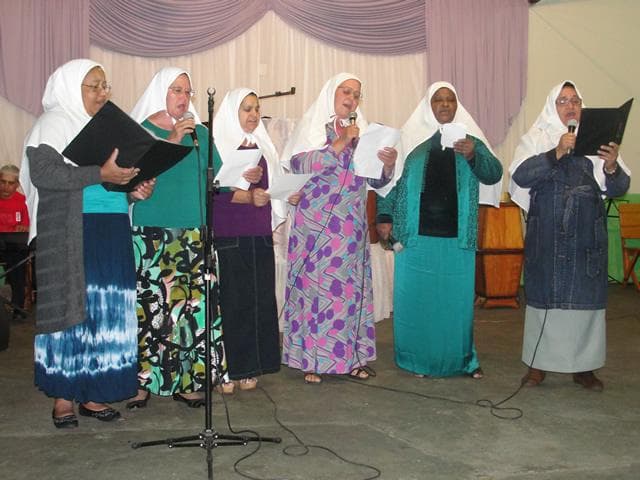
The doctrine related to the use of the veil by Christian women in prayer meetings and worship and praise services to God has biblical basis in the New Testament, in Paul's first letter to the Church in Corinth, in chapter 11, verses 1 to 16:
"... But every woman who prays or prophesies with her head uncovered, dishonors her own head, because it is as if her head were shaved. Therefore, if a woman does not cover herself with a veil, let her cut off her hair too. But, if it is shameful for a woman to cut off her hair or shave it, let her put on the veil..." (verses 5 and 6).
Unfortunately, there are many people who are not interested in obeying the Lord's commandments as stated in the biblical texts, and they raise explanations as scandalous as possible to contradict God's word.
Regarding the commandment of the use of the veil by Christian women, the most frequent is to say that the city of Corinth was a port region and many prostitutes lived there who, upon converting, wore the veil in obedience to Apostle Paul.
This is because, according to tradition, the prostitutes brought with them a notorious sign – they had their head shaved, and thus, the use of the veil would cover their shame until their hair grew again.
Would this be a truth?
Preliminarily, it is suggested that it is not. Let us see:
This fable of bald prostitutes is not found cited in the Bible.
On the contrary, there is something - not much - similar, in the biblical passage of the old testament, in the book of Numbers, in chapter 5 and verse 18 which deals with the woman suspected of adultery:
"Then, the priest shall present the woman before the Lord and uncover the woman's head...".
Furthermore, it is clearly observed that the commandment of the use of the veil is not because the hair is shaved. The biblical text shows that, if the woman does not wear the veil it is as if her head were shaved, and it concludes by determining that, if the woman does not cover herself with a veil, let her then shave her hair, but, if it is shameful for a woman to shave her hair, it is incumbent upon her only to wear the veil.
In that same conduct, but affirming the reason for the use of the veil, Apostle Paul through verse 10 of the same biblical text states:
"Therefore, the woman ought to have a sign of power on her head, because of the angels."
Thus, it must be concluded unequivocally that Paul's commandment regarding the use of the veil is not linked to prostitutes, but to Christian women obedient to the word of God.
In another way, but with the same intention of casting doubt on the doctrine of the use of the veil, there are teachings stating that the biblical text in reference only affirms that the hair is given in place of the veil, and therefore, there is no sentence from Paul in the sense of properly using the veil.
The way Paul's arguments are arranged in the biblical text, at the very least we believe that the Apostle would not have written a letter to the Church dealing with the use of the veil, and then conclude that none of this has value or none of this is necessary. One never reads a letter from end to beginning. But, unfortunately, there are those who read the Bible from end to beginning, and in this case, they read I Corinthians, chapter 11 from verse 16 to verse 01.
This is because, it is evident that the Apostle would not order so emphatically through verses 5 and 6, that Christian women should wear the veil, and then conclude in verse 15 that the hair is already the veil.
In addition to contradicting his own argument regarding the use of the veil, it would put verse 04 in crisis, which says that "every man who prays or prophesies, having his head covered, dishonors his own head", for if hair is a veil, men are also wearing a veil.
In the original Greek translation, the word veil is not used but rather mantle. And everything that is given in place of something, is not the thing itself.
Now, if the apostle writes: 'cover the head', and if hair is the veil itself, there would be no need to cover, it would already be covered; but since hair is hair and veil is veil, there should be no contradiction: '...let her put on the veil...' (verse 6).
There is no biblical contradiction and Paul, being inspired by the Holy Spirit, was emphatic in his teachings.
For these reasons, the doctrine of the use of the veil by Christian women must be preserved by the true Church of the Lord Jesus.
Being the Church in Corinth the type of Church, truly carnal, there were many deviations from the principles taught by Apostle Paul. It is clear that the gifts of tongues and prophecy were the most abused, with even women praying and prophesying without the use of the veil and they began to have a participation in the worship, which had not been taught to them, and with this the emotional state took the place of spirituality.
It was because of these deviations that Paul had the need to write them a letter dealing with authority, order in worship, the Lord's Supper, the worldly spirit and, the unity of the body of Christ. This so that the Corinthians would remember what had already been taught to them verbally, including the use of the veil by women.
The biblical text in our hands requires expressly the use of the veil. Any other contrary interpretation is forced, poorly informed, resulting from superficial and even dishonest erudition.
The orientation of the Apostle is to use a veil with the purpose of covering the hair, making it disappear from sight, therefore, a head cloth or a gauze covering (a type of fabric that does not seal) is not a veil.
When someone ceases to believe only in parts, but receives in whole the Holy Scriptures, they are absolutely invited to accept that, Christian women are ordered not only to use the veil when they pray or prophesy, but also to use long hair. Such a veil must truly cover the hair.
For other reasons the veil was an important part of ancient customs, being used also socially. However, the Church was not given a social custom - this has ended. On the contrary, God's Word continues, and through it, the use of the veil is not recommended as a social practice, but rather as a religious one, that is, for the woman to pray and prophesy.
The woman is not spiritually inferior to man, but is subordinate to him in this earthly sphere, especially to her own husband. She cannot imitate pagan priestesses, frenzied with disheveled hair who did not practice the use of the veil. It is incumbent upon them, therefore, to wear long hair which is natural to her (symbol of her husband's authority over her) and to wear a veil on her head, on certain occasions, which serves as a symbol of her subjection.
In verses 5, 6, 9, 10, 12, 13 and 15, we have a very clear teaching that the woman should wear the veil when she prays or prophesies. Therefore it is a spiritually suicidal interpretation to make verses 15 and 16 contradict the "general" teaching of this passage, assuming that the hair of women (if long, as the text requires) was given to them in place of a veil, or as a substitute for the veil, making its use unnecessary.
Equally incoherent and contrary to the ethics of the biblical text, would be that interpretation which assumes through verse 16 that Paul would have stated himself willing to avoid the subject, allowing women to do as they pleased, if any man desired to raise an objection about this matter.
That is not what Paul teaches through verse 16. If we believe that the totality of the scriptures, despite social modifications, must be followed to the letter, then the use of the veil is something obligatory for the woman to pray and prophesy. If the Christian woman were to use the veil by custom, observing the historical context, such use would be continuous and not only for praying and prophesying.
The modest women, participants of the Church in the apostolic days used two types of veil. The first one, which was natural, consisted of their long hair - it was their beauty and their glory created by God. The second, was the veil over the hair, the use of which is a sign of power before the angels in special moments of prayer and worship to God.
The first veil is distinguished from the second, through the use of the word 'mantle' (in Greek 'peribolaion'), which according to verse 15, was given to woman because of her own nature. The second veil was made of cloth and covered the head and consequently the hair, and was worn by the Christian woman when she was to pray or prophesy. This second veil was not natural, for Paul, in teaching about its use, resorts to the verb "to wear" and to the verb "to put", now, if there were only the natural veil (long hair), one could not "put" and neither "remove" it, nor did Paul have the need to remind the sisters to bring the veil.
We cite below some arguments on this subject, used by students of God's Word:
"If a woman refuses to wear the veil, let her, correctly, make herself masculine, by cutting her hair very short: if she does not want to wear a veil, let her wear her hair cut close". (Robertson and Plummer, in loc.).
"If she despises the covering provided by divine ordinance, let her also undo the covering provided by nature" (Chrysostom, in loc.).
"If a woman insists on her right to pray and speak in an assembly, with her head uncovered, then, let her carry this principle to its logical consequences, let her insist on the right to wear her hair cut short, in order to show her equality with man, and what would be thought of her then? No woman with a spark of shame in her would think of doing this." (John Short, in loc.).
"'...Let her cut off her hair...' These words were not said as a permission, but rather express a commandment that establishes the legitimate consequence of how improper it is for a woman not to veil herself... if she is willing to do one of these things, let her do the other equally" (Kling, in loc.).
Notwithstanding the facts already exposed, we judge it pertinent in continuity with the subject, to analyze and detail some aspects related to the biblical texts in question (I Corinthians, 11.1-16):
Verse 8: 'For man was not made from woman, but woman from man.'
Paul here makes reference to the text of Genesis, 2.22 drawing from creation the inference of the priority of man and, for this reason, too, there are non-testamentary instructions in the sense that the woman should learn in silence, with all subjection (I Timothy, 2.11-13).
It is also recalled that, it was the woman and not the man who was deceived by the devil (I Timothy, 2.14), and the narrative of Genesis makes clear that the woman was created for the benefit of man, and not the other way around.
These biblical facts evidence the hierarchical order of powers and authorities, as well as the propriety of the woman's subjection to man, and, consequently, how appropriate it is for the woman to wear a veil when praying or prophesying as a sign of absolute subjection and relative authority before God himself present in these occasions.
Verse 10: 'Therefore, the woman ought to have a sign of power on her head, because of the angels'.
Given what has been exposed, Paul now establishes even more firmly his affirmation that the Christian woman should wear the veil (naturally, when she prays or prophesies, as read in verse 4).
The woman is subordinate to man from creation, having been made 'of" man and 'for' man. And it is incumbent upon her to wear the veil in order to show this position of subordination and at the same time of relative authority that belongs to her in the meetings of prayer and worship to God.
For a woman not to wear the veil was a sign of disrespect to man, in an attempt to be equal to him as regards dress and customs in ancient society. Customs and society may change, but has God's Word changed? Certainly not!
At this point Paul says '... because of the angels...'. The angels referred to here are the holy angels present at the time of the worship meeting of the people, acting as guardians of the order established by God, and guardians of the Church.
It would be an offense for certain excessively emancipated women not to wear their veils anymore. Such affront would not only be against men by lack of submission, but also against the angels by the sign of authority, for it would break the hierarchy established by God.
'The house of prayer is a court adorned with the presence of celestial powers: there we are, singing and intoning hymns to God, singing with the angels among us as our associates; and it was with allusion to them that the apostle required such great care, with regard to decency, because of the presence of the angels'. (Hooker, in loc).
"To wear a veil on the head". This affirmation is not a translation of the biblical text, but rather an interpretation. The original Greek says, literally, '...this is the reason why a woman should have power (or authority) over her head...'.
The Greek word 'eksousia' obviously refers to the veil: but some scholars feel difficulty in understanding how the veil could be called 'power' when the entire rest of the passage refers to the veil as a symbol of the opposite idea, that is, of 'subjection'.
But the veil becomes a symbol of the authority that the husband exercises over his wife, as it is also a symbol of her own subjection to him. And this double symbolism is not difficult to be understood.
Verse 13: 'Judge for yourselves: is it proper for a woman to pray to God uncovered?'.
From this question onwards, Apostle Paul opens an opportunity for personal judgment, considering all his teaching. One must consider that this particular judgment always takes into account nature, social and religious customs.
In the ancient city of Corinth, such influence could only result in one answer: "women need to wear the veil, if they are women of respect".
It was not advisable there for a woman to imitate prostitutes or worshippers of pagan rites, by removing the veil in an attempt to emancipate herself and obtain social equality with men.
We know that pagan priestesses also did not wear the veil; and, in their contortions, their hair became disheveled and uncombed. Now, no Christian woman would desire to imitate this form of feminine conduct.
Paul appeals to the law impressed on human minds because he knew that natural man often manages to form a correct judgment based on his intuition. The Apostle expected the people in Corinth to be taught by their own inner testimony and by nature, regarding the recognition of the only acceptable custom for the Christian church, namely, the use of the veil by women at times of prayer and worship to God.
'By rejecting the emblem of subjection (the veil), the woman in one leap when praying in public, surpasses both men and angels'. (Bengel, in loc).
The apostle of the gentiles was not a senseless and uneducated man to the point of contradicting himself when he wrote that hair was given in place of the veil (which in the original says: mantle).
In this sense Findley also expressed himself: 'and not as a substitute for the veil, because that would make Paul's words foolishness; but rather, in the nature of a covering, something that is equivalent to the veil".
'And it is an indisputable fact that long hair, on a man makes him contemptible; but, on a woman, long hair makes her friendlier. Nature and the apostle speak the same language: we can try to explain this however we like'.(Adam Clarke, in loc.).
Verse 16: 'But if anyone wants to be contentious, we do not have such a custom, nor do the churches of God'.
Many modern interpreters without erudition have twisted this scripture, affirming that if Christians in Corinth did not agree with the expressed doctrine, Apostle Paul would be ready to forget all his arguments and let each local church decide how it was fit to act.
Such interpretation clashes with the entire context, it would never be sensible to affirm that Paul exposed the teaching with many arguments and examples in favor of the use of long hair and the veil, only to determine at the end that if opposition were found, everything would be disregarded.
This type of modern interpretation that has developed exists because of a 'modern necessity' that tries to make the Apostle say what one wants to hear, but ignores what he really taught.
Speaking to this, Robertson and Plummer satisfactorily pronounced themselves (in loc):"What Paul establishes here is: If anyone is inclined to debate, we do not recognize any other practice, and neither do the churches of God, but if anyone seems to be contentious, we do not have such a custom (as that someone proposes), and neither do the churches of God."
In this way, Paul cut off "at the root" any attempt to dispute the matter, appealing to universal use among Christians; and in order to make this appeal more solemn, he gives emphasis by affirming that the churches of God throughout the world adopt the use of the veil.
In the New Testament by the illustrated edition 'Love is Most Important', published by the World Bible League based on the famous English Bible 'The Living Bible' an explanation is given regarding verses 4 to 7 very easy to understand.
'Here is why, if a man refuses to remove his hat while he is praying or preaching, he disrespects Christ, here is why a woman who prays or prophesies publicly without her head being covered, disrespects her husband (for covering the head is a sign of her subjection to him). If she refuses to cover her head in this case she should cut all her hair off. And if it is shameful for a woman to have her head shaved, then she should cover it. A man, however, should not wear anything on his head when he is in worship, for the hat is a sign of subjection to men".
Finally, we can then conclude that these biblical matters are commandments of the Lord and only those to whom they are revealed receive them.
In the book of creation – Genesis, 24.64-65, we see in Rebekah a type of the Church (which was called the Virgin Bride of Christ), and in Isaac, the type of the bridegroom (Christ) who goes out to meet his bride to receive her. The church – the bride - who awaits the bridegroom anxiously for that great day of rapture.
This revelation is for that great day of rapture. This revelation is for those who are by the well (Beer Laai-Roi), the well or cistern of the one who lives and sees me, but to those by the well (Eseque), which means contention, the Apostle Paul says that if anyone wants to be contentious we have no such custom, nor do the Churches of God.
Scofield says regarding the veil in the footnote comparing with Genesis 3.16: 'The woman's veil or covering for her head is a symbol of her subordination. According to verse 5 of I Corinthians 11, the covering seems to be definitely related to women praying or prophesying in the meetings of the Church'.
The contradictors immediately cite the text of II Corinthians, 3.16: "But when they turn to the Lord, the veil is taken away from them". But that refers to the veil of Moses's face, and not the veil for the woman's use (read verse 13).
The Apostle Paul still writes in his second letter to the Church of Corinth in chapter 3, verses 5 and 6: "because the letter kills and the Spirit gives life". The ministry of death engraved with letters in stone, is what had glory, but now it no longer shines before the current glory of Jesus Christ.
The letter of the Law kills, but the grace of the Gospel gives us life!
Want to know more about the veil? See the videos below:
Do you have any questions or suggestions? Do not fail to get in touch with us. We will be ready to answer you.
Be sure to comment and share this article. Let's together spread God's Word.
Adapted from the book: "WHAT IS WORK IN RESTORATION?", Pastor Samuel Alves de Arruda, Editora Maanaim, 1995, 1st ed.