
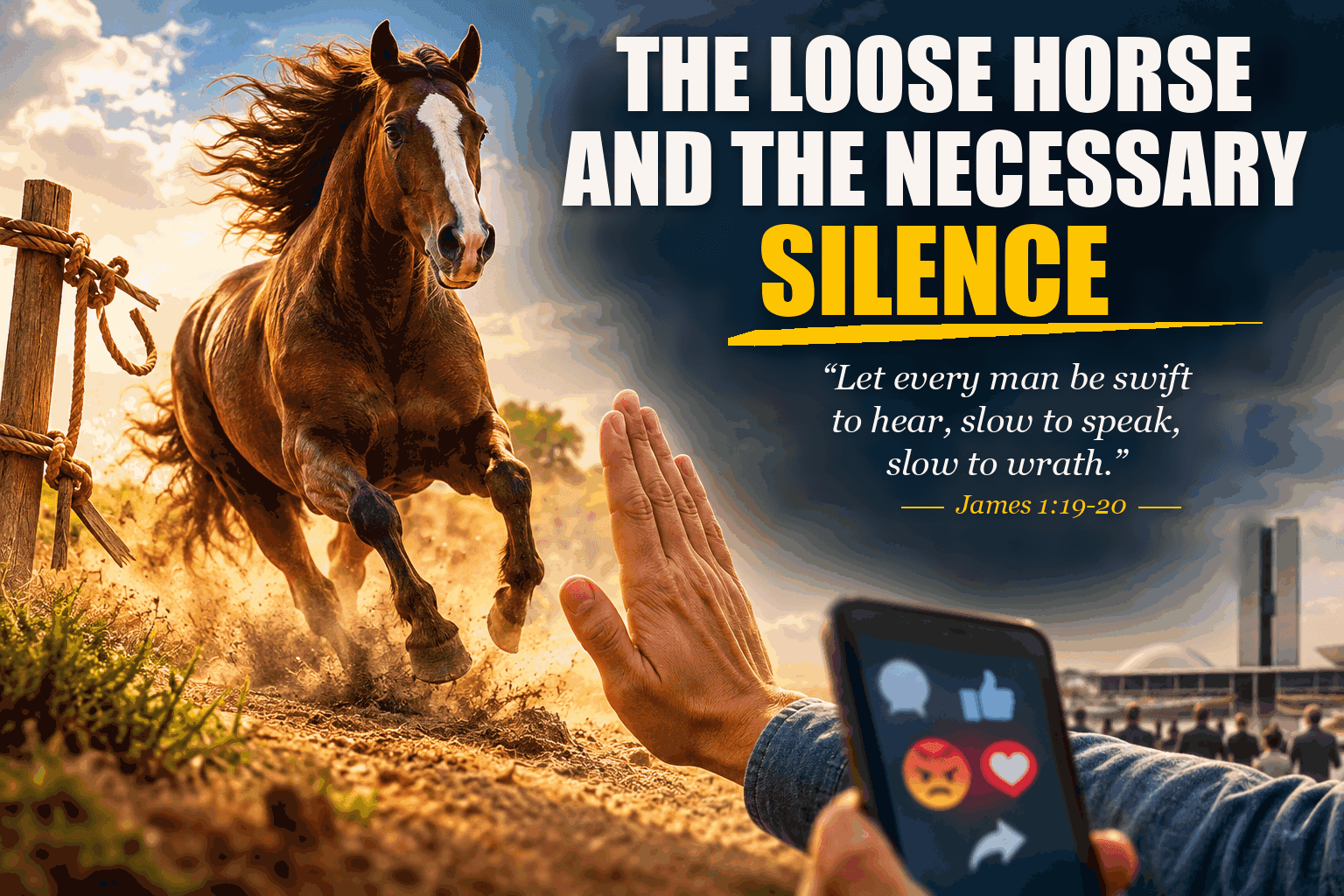
The Loose Horse and the Necessary Silence
“Wherefore, my beloved brethren, let every man be swift to hear, slow to speak, slow to wrath: for the wrath of man worketh not the righteousness of God.”
James 1:19-20
In the speed of modern times, politics often ceases to be the art of understanding and becomes a field of automatic reactions. An old parable, passed down through generations, serves as a crystal-clear mirror of our social behavior: the story of the day the devil merely untied a horse.
Once free, the animal broke into the neighbor’s garden and devoured the crops. The owner of the garden, seized by fury over his loss, killed the horse. The horse’s owner, wounded in his pride and in his property, took revenge on his neighbor. Before long, the entire neighborhood was in flames, divided by grief and irreconcilable grudges. Asked about the size of that tragedy, the provocateur simply said: “I didn’t do anything. I just let the horse loose.”
This metaphor resonates with overwhelming force in today’s public arena. Every day, “horses are let loose” on social media and in public debate. They come in the form of deliberately ambiguous statements, fabricated rumors, irony calculated to wound, and posts designed to trigger our deepest emotions. The goal is rarely to build; it is to test our flash point.
The true awakening this story calls for lies not in pointing a finger at whoever lets the horse loose, but in noticing our own haste to pull the trigger of reaction. With alarming ease, we become the executors of someone else’s discord. We accept the invitation to conflict without asking whether the cause is just, whether the facts are true, or whether the price to be paid — friendships destroyed, family ties frayed, dialogue broken — is worth a moment on the soapbox.
We forget the wisdom of Proverbs 15:1: “A soft answer turneth away wrath: but grievous words stir up anger.” Choosing gentleness is not weakness; it is refusing to feed someone else’s fire.
At its noblest, politics should be the place where we stitch the social fabric together, not where we tear it apart. When we react with blind fury to every provocation that appears on a screen or from a podium, we surrender our autonomy and become puppets of a machine that feeds on our outrage.
In the face of this arena of automatic reactions, the call to clear thinking is summed up in the words of the apostle James, who urges us to be swift to hear and slow to speak and to anger, for human anger does not produce the righteousness of God. When we choose to pause instead of striking back, we break the cycle of destruction set off by the “loose horses” that inflame public debate and divide society.
This ancient wisdom reminds us that true justice and social peace are not born of heated political rallies or of the blind outrage our screens feed every day. On the contrary, they require the courage to master our own impulses and to silence our pride when everything around us invites confrontation.
When we guard our hearts against the rush to judge and the fury to respond, we regain mastery over ourselves and keep outside provocateurs from dictating our steps and feelings. May our answer to the noise of the world, then, be the steadiness of a conscious, peacemaking silence.
After all, refusing to strike the match of intolerance is the only safe way to protect the social fabric and to keep from becoming sad instruments of our own ruin.
Pastor Wilson de Lima Salustiano
Master’s in Pastoral Psychology
facebook.com/pr.wilsonsalustiano
Votorantim – SP, Brazil