
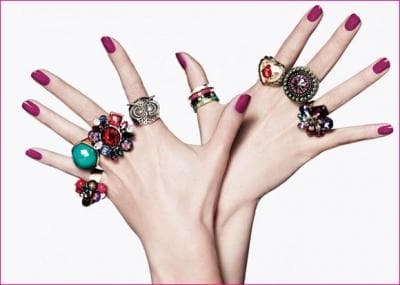
The use of jewelry, ornaments, makeup, inappropriate clothing, etc...
We were called to make a difference.
We are "the salt of the earth" and "the light of the world" and, for this, Jesus has demanded sanctification of His Church.
Mainly our sisters have made this difference through the way they conduct themselves in society.
Distinguished in every way from worldly women, having modesty in their attire, keeping their hair long, not painting their faces and neither using artifices, jewelry or trinkets.
But how to explain such conduct if the use of jewelry and makeup has been defended by many individuals and religious communities?
Perhaps this indifference is due, in large part, to the desire not to upset groups and people.
This is not the biblical position or the prophetic guidance received by the Church. The matter is important and involves more than the opinions of any particular group.
The relationship between jewelry and apostasy is frequent in the Bible. Let us see:
1 – In Ezekiel 23:38-43 – It symbolically reports God's people as two worldly women, idolaters, who called lovers and for them painted their eyes and put ornaments; the drunkards of the desert gave them bracelets and diadems and they committed adultery.
2 – In Isaiah 3:16 to 26 – It describes the women of Isaiah's time as they were: vain, arrogant, haughty, proud, more interested in themselves than in the Lord or in the needs of those around them. The chapter is dedicated to warning of the apostasy of Judah and Jerusalem. It is evident the symbolic connection of vain ornaments with apostasy. The Lord would strike at the strongest point of sin.
3 – Hosea 2:13 – God tells of the origin of ornaments for His apostate people: “Pendants of Baal and her necklaces”.
4 – II Kings 9:30 – Jezebel, the apostate, painted her eyes and adorned herself to seduce.
5 – In Genesis 35: 1 to 5 – We find a literal example of how the abandonment of ornaments and idolatry relates to reconsecration to God. The attitude of Jacob's sons leaving the idols and earrings is explained in Patriarchs and Prophets Decided (Jacob) that before going to that sacred place (Bethel) his house should be free from the contamination of idolatry: "(...) his sons were also touched by a power that constrained them; (...) then they gave Jacob all the strange gods that they had in their hands and the earrings that were in their ears..."
Therefore, undoubtedly they believed that the elimination of strange gods and all disturbing ornaments was necessary, if God was to be sincerely worshiped.
6 – I Timothy 2:9-10 – Makes direct recommendation of modesty and simplicity: “Likewise also that women adorn themselves in modest apparel, with shamefacedness and sobriety; not with broided hair, or gold, or pearls, or costly array; but (as becometh women professing godliness) with good works.”
Therefore, the departure from God's ideal plan regarding external adornment has been, for many, motivated by frank rejection of Jesus' teachings in His Word.
The apostle Peter (I Peter 3:1-5) says that the simple behavior of Christian women contributes to the conversion of unbelieving husbands. The apostle continues with clarity: “Whose adorning let it not be that outward adorning of plaiting the hair, and of wearing of gold, or of putting on of apparel;” (verse 3)
Paul speaks of modesty (I Tim. 2:9, 10) a reference to decent clothing, warnings, indeed, very appropriate for short, tight, transparent and low-cut clothes that many organizations consent to as normal.
How can we be the light of the world if we are not Christians only in name? Let us be, therefore, Christians, not merely in name, but also in clothing and conversation. Let us be satisfied with dressing modestly, not with tufts and feathers and unnecessary ornaments.
The primitive church also maintained this position of modesty avoiding jewelry and makeup, as demonstrated by biblical references.
Young people in restoration, our willingness to dress according to fashion, using, to satisfy vanity, gold and artificial things, does not recommend to others the religion nor the truth that you profess.
Discreet people will consider our desire to adorn ourselves as proof that we possess weak mind and vain heart. If the dwelling of the Holy Spirit is important to us, we will cultivate the ornament of a meek spirit, rather than ornaments of gold and silver (jewelry) earrings, bracelets, necklaces and other human creations, whose purpose is to attract attention to self and not to Christ. ”
Christian testimony is an integral part of spiritual life and any jewelry or makeup, or anything else that gives the appearance of evil or causes scandal must be avoided by those who, without reservation, want to serve God. (I Thess. 5:22 and Rom. 14:13, 21).
Jesse Caleb A. Sanches
jessecalebsanches@yahoo.com.br