
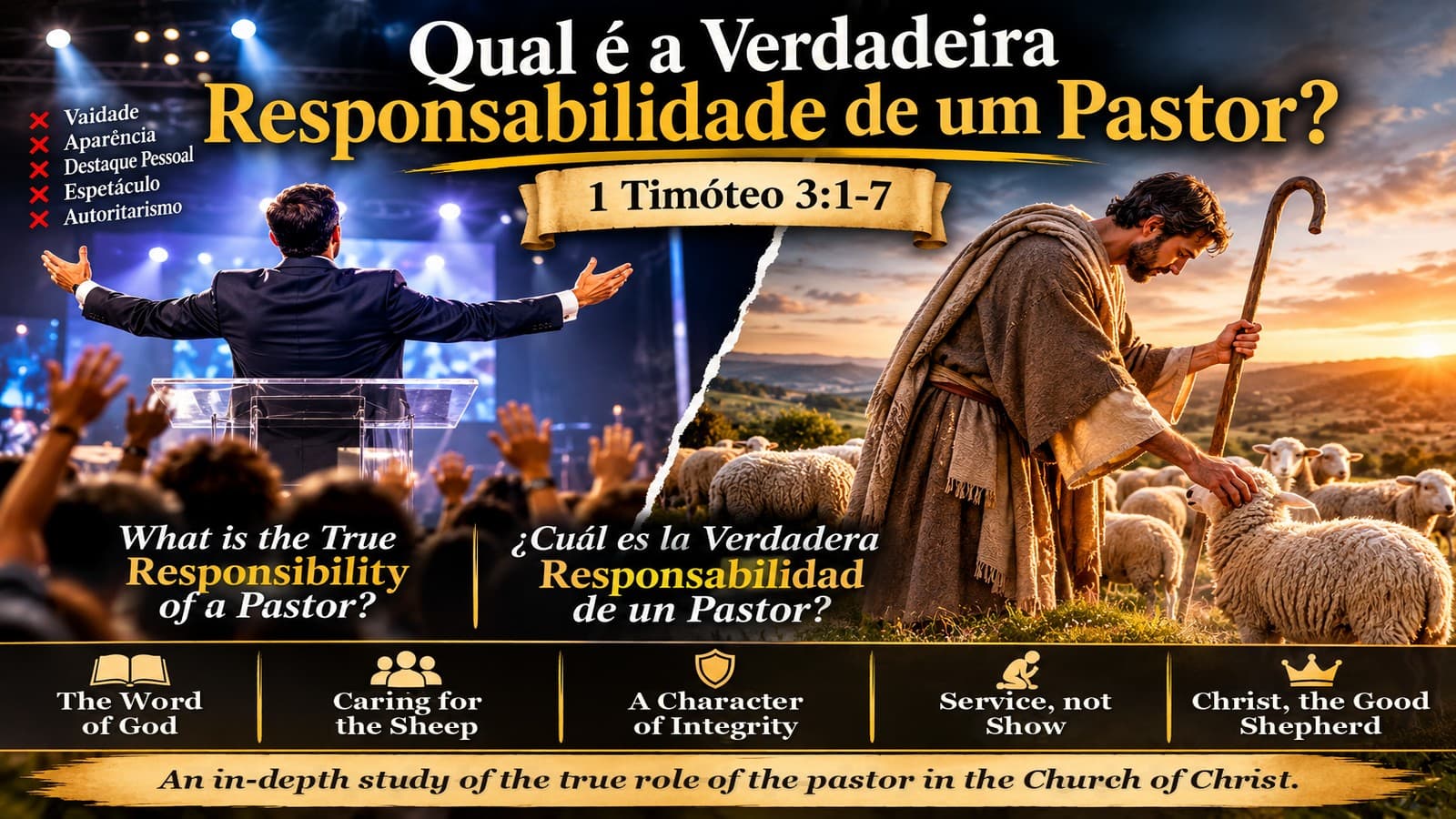

WHAT IS THE TRUE RESPONSIBILITY OF A PASTOR?
The pastoral calling is not a stage for showing off nor a business counter, but a responsibility before God.
Key text: 1 Timothy 3:1-7
“This is a true saying, If a man desire the office of a bishop, he desireth a good work.”
1 Timothy 3:1
Introduction: What does it really mean to desire pastoral ministry?
In our day, we need to reflect deeply on the true meaning of pastoral ministry. What leads someone to desire the pulpit? The desire to serve God and care for souls, or the wish to receive recognition, prominence and admiration from people?
The Word of God presents pastoral ministry as a responsibility of great seriousness. It is not simply about speaking before a congregation, holding a title, leading meetings or occupying a position of authority. It is about caring for people for whom Christ gave His own life.
In 1 Timothy 3:1-7, the apostle Paul gives clear guidance on the qualifications of one who desires the office of a bishop. It is interesting to note that the text does not begin by highlighting eloquence, popularity, the ability to impress crowds or a talent for performing before people. On the contrary, Paul begins by speaking of character, conduct, self-control, testimony and family responsibility.
This leads us to a necessary question: are all those who desire the pulpit truly willing to take on the responsibility that comes with it?
Ministry must not be confused with an opportunity for self-promotion. Before desiring to be seen before the Church, one must show, in everyday life, a willingness to serve. Before desiring to care for the flock, one must show responsibility for what God has already placed in his care, beginning with his own home.
In this study, we will examine biblically what it means to be a pastor, what qualifications the Word of God requires, and why the pulpit must never be turned into a stage for vanity and display.
1. The office of a bishop is a good work, not a position of prominence
Paul writes:
“This is a true saying, If a man desire the office of a bishop, he desireth a good work.”
1 Timothy 3:1
The expression Paul uses is very significant. The apostle does not present the office of a bishop as a position of prestige, but as a good work.
In the Greek text, the expression kalou ergou can be understood as “good work” or “excellent labor.” The word ergou is related to work, labor and activity.
Therefore, to desire pastoral ministry means to desire to take on a work that requires dedication, responsibility, self-denial and commitment.
We need to understand this difference: it is one thing to desire the recognition that may accompany a position; it is another to sincerely desire the work and responsibilities that this position demands.
The pastor was not called to be served, but to serve. He was not called to build his own reputation, but to proclaim Christ. He was not called to seek applause, but to care for souls.
Jesus taught:
“Even as the Son of man came not to be ministered unto, but to minister, and to give his life a ransom for many.”
Matthew 20:28
If the Lord Jesus Himself presented service as a fundamental characteristic of His mission, how could anyone desire to exercise a role of spiritual leadership without understanding the value of service?
The desire for the office of a bishop must be accompanied by the desire to work. It is not enough to want the title; one must be willing to take on the commitment.
2. Before caring for the Church, one must show responsibility at home
This is one of the most important points for understanding the ministerial qualifications Paul presents.
Speaking of the one who desires the office of a bishop, the apostle declares:
“One that ruleth well his own house, having his children in subjection with all gravity.”
1 Timothy 3:4
And then he asks a question that cannot be ignored:
“For if a man know not how to rule his own house, how shall he take care of the church of God?”
1 Timothy 3:5
Paul’s question establishes a direct connection between family responsibility and ministerial responsibility.
It is not consistent for someone to want to care for a congregation while neglecting those who are under his responsibility in his own home. It is not reasonable to want to teach the Church about love, care, faithfulness and responsibility while his own family does not find these principles in his conduct.
The Word of God also gives an even more serious warning:
“But if any provide not for his own, and specially for those of his own house, he hath denied the faith, and is worse than an infidel.”
1 Timothy 5:8
This statement should lead us to deep reflection.
Paul does not treat family responsibility as a secondary detail of the Christian life. He shows that caring for one’s own family is directly related to the consistency of the faith one professes.
The text states that whoever does not provide for his own has denied the faith and is worse than an unbeliever. It is an extremely serious warning, one that cannot be ignored by anyone who wishes to take on spiritual responsibility for other people.
It is important to note that 1 Timothy 5:8 is part of instruction about caring for family members, especially in the context of supporting widows. Nevertheless, the principle is clear: the faith we profess must produce concrete responsibility toward those under our care.
So, before desiring to occupy the pulpit, a man must examine his own family life.
Has he been responsible toward his wife and children?
Has he shown love, respect and care at home?
Does his family know, in practice, the principles he teaches publicly?
Has he taken on his responsibilities, or does he use ministry as an excuse to neglect his home?
Does his conduct at home confirm or contradict what he presents in the pulpit?
We must understand that dedication to ministry does not mean abandoning one’s family.
God’s calling must never be used as an excuse to neglect responsibilities that were also established by the Word of God itself.
It is not enough to show a willingness to spend hours at church, attend meetings or carry out ministry activities. One must also show faithfulness in everyday commitments, especially at home.
The family should not receive only the leftovers of the time, attention and care of someone who wants to be recognized as a pastor.
This does not mean that a pastor must have a perfect family, free of difficulties or conflicts. No family is free from challenges. It does mean, however, that he must show responsibility, maturity, love and commitment toward his own.
Whoever desires to care for God’s flock must show that he understands the value of caring for those whom God has already placed under his responsibility.
3. The pulpit is not a stage for spectacle and self-display
There is a great difference between using the pulpit to proclaim the Word of God and using it as a tool for self-promotion.
The pulpit must not be turned into a stage where someone tries to show off his abilities, win admiration, feed his own vanity or build an image of spiritual superiority.
The apostle Paul declared:
“For we preach not ourselves, but Christ Jesus the Lord; and ourselves your servants for Jesus’ sake.”
2 Corinthians 4:5
This statement gives essential guidance to everyone who ministers the Word: the center of the message must be Christ, not the preacher.
When someone uses the opportunity to teach in order to promote his own image, exalt his personality or seek recognition, he runs the risk of diverting attention from what truly matters.
The pulpit is not a place to feed vanity. It is not a space for competition, contests for recognition or displays of superiority.
Preaching must not be a show in which the preacher becomes the main attraction. The message must lead people to the Word of God.
This does not mean that preaching should lack clarity, enthusiasm or good communication. It means that the tools used must serve the message, not the personal exaltation of the speaker.
The problem is not that someone is recognized for his dedication or has the gift of communication. The problem begins when recognition becomes the goal and the ministry begins to revolve around the preacher’s personality.
The true servant does not seek to build a stage for himself. He seeks to lead people to Christ.
4. The pastor does not own the sheep
The apostle Peter gives very clear guidance to those who exercise spiritual leadership:
“Feed the flock of God which is among you, taking the oversight thereof, not by constraint, but willingly; not for filthy lucre, but of a ready mind; neither as being lords over God’s heritage, but being ensamples to the flock.”
1 Peter 5:2-3
Notice that Peter calls the Church the flock of God.
The sheep do not belong to the human pastor. They belong to the Lord.
The pastor receives the responsibility to care for, guide and spiritually feed the flock, but he must never act as the owner of the people under his care.
Pastoral authority does not grant the right to humiliate, despise, intimidate or dominate the brethren.
The text is explicit in teaching that the pastor must not act as one who lords it over God’s heritage, but must be an example.
Christian leadership must not be exercised through threats, pressure or spiritual manipulation. Authority must be accompanied by character, humility, responsibility and faithfulness to the Word.
The pastor must understand that he, too, is a sheep under the care of the Chief Shepherd, Jesus Christ.
Therefore, no one should confuse spiritual authority with personal superiority.
Whoever has received the responsibility of caring for people must treat them with respect, patience and love, remembering that every soul is precious before God.
5. The example of David the shepherd: faithfulness before recognition
The story of David teaches an important lesson about responsibility and care.
Before taking the throne of Israel, David carried out a seemingly simple task: he tended his father’s sheep.
When he stood before Saul to speak about facing Goliath, David told how, while tending the flock, he had faced a lion and a bear that had carried off a sheep.
“And David said unto Saul, Thy servant kept his father’s sheep, and there came a lion, and a bear, and took a lamb out of the flock: And I went out after him, and smote him, and delivered it out of his mouth.”
1 Samuel 17:34-35
David did not show care only when someone was watching. He took responsibility for protecting what had been entrusted to him.
His commitment was not conditioned on public recognition.
Caring for the sheep required a willingness to face danger, take risks and not abandon the flock in the face of difficulties.
Later, Psalm 78 shows the connection between this experience and David’s calling to lead the people of Israel:
“He chose David also his servant, and took him from the sheepfolds: [...] to feed Jacob his people, and Israel his inheritance. So he fed them according to the integrity of his heart; and guided them by the skilfulness of his hands.”
Psalm 78:70-72
The passage highlights two characteristics: integrity of heart and skill in leading.
It is important to notice that David was not chosen by God because he already held a prominent position before people. His journey reveals that God can prepare someone through tasks that, in human eyes, seem simple and receive little recognition.
David was also called a man after God’s own heart (Acts 13:22), even though he was not a perfect man and committed serious sins.
His story teaches us that care, responsibility and integrity are important characteristics in the life of anyone who receives a mission.
Pastoral work does not begin on the platform, in the pulpit or before a congregation. True commitment to caring must be part of a person’s life.
6. Psalm 23 reveals the character of the true Shepherd
David, who knew the responsibility of caring for sheep, wrote:
“The LORD is my shepherd; I shall not want.”
Psalm 23:1
It is significant that David used his experience as a shepherd to express God’s care.
Psalm 23 presents fundamental characteristics of pastoral care:
Leading: “He maketh me to lie down in green pastures: he leadeth me beside the still waters” (verse 2). The shepherd leads the sheep to places of nourishment and rest.
Restoring: “He restoreth my soul” (verse 3). Care is not limited to external needs; it also involves restoration and strengthening.
Guiding: “He leadeth me in the paths of righteousness for his name’s sake” (verse 3). The pastor must guide the flock along the right path, according to the Word of God.
Accompanying: “Yea, though I walk through the valley of the shadow of death, I will fear no evil: for thou art with me” (verse 4). True care does not disappear when difficulties arrive.
Protecting: “Thy rod and thy staff they comfort me” (verse 4). Protection is part of pastoral responsibility.
Psalm 23 does not present a shepherd interested in being seen, but one who leads, feeds, restores, accompanies and protects.
It is important to remember, however, that David uses this image to speak of the Lord Himself. Perfect care belongs to God.
The human pastor must learn from this example, recognizing that his responsibility is to serve the flock, not to take the Lord’s place.
7. God’s warning against bad shepherds
In Ezekiel 34, we find one of the strongest warnings in Scripture against those who should have cared for the people but began to care only for themselves.
God rebukes the shepherds of Israel because they were concerned with their own interests while neglecting the flock.
“Woe be to the shepherds of Israel that do feed themselves! should not the shepherds feed the flocks?”
Ezekiel 34:2
The Lord lists a series of failures:
They fed themselves but did not properly care for the sheep.
They did not strengthen the weak.
They did not heal the sick.
They did not bind up the injured.
They did not bring back those that had strayed.
They did not seek the lost.
They ruled with force and cruelty.
The situation was so serious that God declared:
“My sheep wandered through all the mountains, and upon every high hill: yea, my flock was scattered upon all the face of the earth, and none did search or seek after them.”
Ezekiel 34:6
This passage presents a very strong contrast between true care and self-interest.
The bad shepherds were concerned with themselves. The sheep, however, were abandoned.
The warning remains relevant as a principle for spiritual self-examination: whoever receives the responsibility of caring for God’s people cannot turn ministry into a tool for satisfying personal interests.
The Lord also declares that He would require His sheep at the hands of those shepherds and that He Himself would search for and care for His flock (Ezekiel 34:10-16).
Further on, God announces that He would raise up one shepherd over them, called David:
“And I will set up one shepherd over them, and he shall feed them, even my servant David; he shall feed them, and he shall be their shepherd.”
Ezekiel 34:23
This promise points to the messianic care of Christ, the descendant of David, the true Shepherd of God’s people.
The message is clear: God is not indifferent to the way His sheep are treated.
8. Pastoral ministry is not a means of getting rich or a spiritual business
One of the clearest warnings in Scripture concerns the spiritual leader’s relationship with money and material possessions. When Paul lists the qualifications for one who desires the office of a bishop, he explicitly states that the candidate must not be covetous (1 Timothy 3:3) nor given to filthy lucre (Titus 1:7).
The apostle Peter reinforces this same truth by instructing the elders to care for God’s flock “not for filthy lucre, but of a ready mind” (1 Peter 5:2). The expression “filthy lucre” (aischrokerdōs, in the original Greek) refers to shameful or dishonest gain, or gain obtained by exploiting other people’s faith.
It is essential to understand that the Bible does not condemn the fair support of those who devote themselves fully to God’s work. Paul himself teaches that “the labourer is worthy of his reward” (1 Timothy 5:18) and that “they which preach the gospel should live of the gospel” (1 Corinthians 9:14). Pastoral support is a biblical provision so that the minister can take care of his family and devote himself to teaching and caring for souls.
The theological and moral problem arises when support gives way to greed, and ministry comes to be seen as a lucrative career, a family business or a tool for accumulating wealth and flaunting a lavish lifestyle at the expense of the sheep’s sacrifice.
Paul warned Timothy about men of corrupt minds who suppose “that godliness is a means of gain” (1 Timothy 6:5). To them, religion is just a profitable business. Yet the apostle reminds us that “they that will be rich fall into temptation and a snare, and into many foolish and hurtful lusts, which drown men in destruction and perdition. For the love of money is the root of all evil” (1 Timothy 6:9-10).
The pulpit is not a business counter. The Word of God is not merchandise (2 Corinthians 2:17). Whoever uses the pastoral position to get rich, manipulate offerings or turn the faith of simple people into a source of personal luxury dishonors the gospel of Christ, who, though He was rich, yet for our sakes became poor (2 Corinthians 8:9).
9. The difference between the true shepherd and the hireling
To understand how serious it is to exercise ministry out of self-interest, we need to look at the teaching of the Lord Jesus Himself in John 10:11-13, where He draws a definitive contrast between the Good Shepherd and the hireling:
“I am the good Shepherd: the good Shepherd giveth his life for the sheep. But he that is an hireling, and not the shepherd, whose own the sheep are not, seeth the wolf coming, and leaveth the sheep, and fleeth: and the wolf catcheth them, and scattereth the sheep. The hireling fleeth, because he is an hireling, and careth not for the sheep.”
John 10:11-13
In biblical culture, the hireling (misthōtos) was someone hired only for pay. He performed an outward task but had no bond of love, commitment or real responsibility toward the flock. His only motivation was the wage at the end of the day.
Theologically, the difference between the shepherd and the hireling is not in the position they hold, the clothes they wear or the eloquence with which they speak, but in the motivation of the heart and the response to the cost:
Commitment in the face of danger: The hireling stays as long as there is comfort, applause and financial benefit. When the “wolf” appears — whether crises in the church, false doctrines, persecution or complex problems that demand sacrifice with no return — he flees, keeps silent or abandons the flock to save his own skin and protect his own interests.
The value placed on the sheep: For the hireling, the sheep are a means to an end (money, status, power). For the true shepherd, the sheep are precious souls bought by the blood of Christ, for whom it is worth spending one’s own life (2 Corinthians 12:15).
The willingness to renounce: While the hireling asks, “What do I gain from this flock?”, the shepherd after God’s own heart asks, “How can I serve and protect this flock?”
The prophet Zechariah also brings a harsh word of judgment against the “worthless shepherd, who leaves the flock” (Zechariah 11:17). Mercenary leadership is a spiritual fraud because it pretends to care while seeking only personal advantage.
10. When the belly becomes a god
The apostle Paul takes this analysis even deeper by exposing the spiritual root of those who use the gospel for personal gratification. Writing to the Philippians, with tears in his eyes, he denounces leaders and teachers who behaved as “the enemies of the cross of Christ”:
“Whose end is destruction, whose God is their belly, and whose glory is in their shame, who mind earthly things.”
Philippians 3:19
The expression “whose God is their belly” carries remarkable theological depth. In biblical language, the “belly” (koilia) represents fleshly appetites, selfish desires, material comfort, the relentless pursuit of pleasure and self-gratification.
When Paul says that the belly is the “god” of these people, he is diagnosing an idolatry disguised as ministry. Although they speak the name of Jesus, preach from the Bible and hold leadership positions, the real deity they serve and obey is their own desires, their comfort, their well-laden table and their vanity.
In Romans 16:18, Paul repeats this same warning, explaining how such individuals operate within the church:
“For they that are such serve not our Lord Jesus Christ, but their own belly; and by good words and fair speeches deceive the hearts of the simple.”
Romans 16:18
Notice the connection the apostle makes: whoever serves his own belly does not serve Christ. It is spiritually impossible to serve two masters (Matthew 6:24). And to maintain this self-centered lifestyle, such leaders use “good words and fair speeches” — pleasant, emotional and manipulative speech that strokes the listeners’ egos in order to extract from them resources, blind loyalty and support for their own pleasures.
The apostle Jude also describes these false shepherds as those who are “feeding themselves without fear” (Jude 1:12), and Peter warns that, through covetousness, they will “with feigned words make merchandise of you” (2 Peter 2:3).
The call of the cross of Christ goes in exactly the opposite direction to the idolatry of the belly. While the false leader lives to satisfy himself at the church’s expense, the true pastor embraces the cross, denies himself daily (Luke 9:23) and finds his true satisfaction not in earthly goods, but in pleasing the One who enlisted him (2 Timothy 2:4).
11. The biblical qualifications for one who desires the office of a bishop
In 1 Timothy 3:1-7, Paul presents characteristics that must be seen in the life of one who desires to serve as a bishop.
These qualifications are not bureaucratic details or unimportant requirements. They show that pastoral ministry requires spiritual maturity and proven character.
Let us look at each of them:
1. Blameless
This does not mean someone without sin or who has never made mistakes. It means someone whose conduct gives no legitimate grounds for accusations that would compromise his testimony.
2. The husband of one wife
The expression points to faithfulness and seriousness in the marriage relationship. The principle is that the candidate must demonstrate a morally upright life committed to faithfulness.
3. Vigilant and sober
He must be attentive, balanced and aware of his responsibilities. He cannot live ruled by impulses, carelessness or a lack of discernment.
4. Of good behavior
His conduct must be dignified, respectful and consistent with Christian principles.
5. Given to hospitality
He must show a willingness to welcome and serve people, not living closed off in his own interests.
6. Apt to teach
It is not enough to want to speak before the Church. He must know the Scriptures and be able to teach them correctly, with responsibility and faithfulness.
7. Not given to wine
He must not be someone controlled by alcohol or by habits that compromise his discernment and self-control.
8. Not violent
Spiritual leadership cannot be exercised through aggressiveness, intimidation or violence.
9. Moderate
He must show balance and self-control in his attitudes and decisions.
10. Not a brawler
He must not be someone who is always looking for conflicts, arguments and disputes. He needs to know how to act with patience and wisdom.
11. Not covetous
Ministry cannot be motivated by greed or by the desire for financial advantage.
12. One that rules well his own house
This qualification deserves special attention. The candidate must demonstrate responsibility and maturity in leading his family life.
As we have seen, Paul directly links caring for one’s family to the ability to care for the Church of God.
13. Not a novice
He must not be a recent convert or someone lacking sufficient spiritual maturity. Pride can become a snare for those who receive responsibilities before they are ready.
14. A good report from those outside
His conduct must also be respectable before those who are not part of the congregation. The Christian life cannot be a mere appearance confined to the religious setting.
In Titus 1:5-9, Paul gives complementary guidance, reinforcing the need for integrity, self-control, faithfulness to the Word and the ability to exhort with sound doctrine and refute those who oppose it.
Therefore, it is not enough for someone to show a desire to take on ministry. His life must be examined in light of the qualifications established in Scripture.
12. Ministry requires dedication, but it does not justify neglecting one’s family
It is right to say that pastoral ministry requires dedication. There are responsibilities, visits, counseling, times of prayer, teaching, walking alongside people, and situations that demand time and effort.
Paul knew this reality intimately.
In Philippians 2:17, he uses the image of being poured out as a drink offering upon the sacrifice and service of the believers’ faith. In 2 Timothy 4:6, he speaks of his departure, describing his life as an offering poured out.
In 2 Corinthians 11:23-28, he recounts sufferings, dangers, imprisonments, persecutions and his concern for the churches.
This shows that true Christian service involves self-giving and commitment.
However, we must understand that dedication to ministry does not mean abandoning other responsibilities established by God.
A man cannot use service in the Church as an excuse to neglect his wife, his children or other family members under his responsibility.
It is not consistent to counsel families about love and care while leaving one’s own family uncared for.
It is not consistent to teach about Christian responsibility while neglecting basic obligations at home.
Ministry must not be used as a spiritual excuse to cover up personal irresponsibility.
True dedication must be accompanied by balance, wisdom and faithfulness in every area of life.
13. The pastor must give account to God for souls
Pastoral responsibility does not end when a meeting is over or when a sermon has been preached.
The Word of God presents the care of souls as a responsibility before the Lord Himself.
“Obey them that have the rule over you, and submit yourselves: for they watch for your souls, as they that must give account.”
Hebrews 13:17
The text presents a reality that should produce reverent fear and responsibility.
Those who exercise spiritual leadership watch over souls and will give account to God.
This means that ministry cannot be treated lightly.
It is not merely about organizing meetings, managing activities or keeping a religious structure running. It is about caring for lives, teaching the truth and guiding people on the path of faith.
This responsibility should also keep the pastor from using his position to demand blind obedience.
The biblical instruction about submitting to pastors does not mean that their words are above Scripture. All teaching must be examined in light of the Word of God.
The Bereans are held up as an example precisely because they searched the Scriptures daily to see whether what Paul preached was true (Acts 17:11).
John also instructs:
“Beloved, believe not every spirit, but try the spirits whether they are of God.”
1 John 4:1
And Paul teaches that not even a message accompanied by spiritual authority should be accepted if it contradicts the gospel that was received (Galatians 1:8).
Therefore, the pastor must teach faithfully, and the brethren must remain grounded in the Scriptures.
Human authority must never take the place of the authority of the Word of God.
14. The true Shepherd is Jesus Christ
When speaking about pastoral ministry, we must not lose sight of the One who is the perfect example.
Jesus declared:
“I am the good Shepherd: the good Shepherd giveth his life for the sheep.”
John 10:11
Christ did not seek to use people to build His own reputation. He gave His life for them.
In 1 Peter 5:4, Jesus is presented as the Chief Shepherd, the One who will reward those who serve faithfully.
This establishes a fundamental distinction: the human pastor exercises a temporary and limited responsibility, while Christ is the true Lord and Shepherd of the Church.
No man should put himself in Christ’s place, claim for himself the honor that belongs to the Lord or act as if he owned the congregation.
The earthly pastor also needs to be shepherded. He, too, needs to learn, correct his mistakes, examine his conduct and submit to the Word of God.
The perfect example is not found in any man, however respected he may be, but in Jesus Christ.
15. A doctrinal note on the pastoral office
When dealing with ministerial qualifications, we must also consider the biblical guidance on the exercise of the pastoral office.
The doctrinal understanding adopted in this study is that the office of elder or pastor, in the sense of spiritual authority and governance of the Church, is reserved for men, according to the interpretation of passages such as 1 Timothy 2:11-14, 1 Timothy 3:1-7 and Titus 1:5-9.
This understanding does not mean that women are inferior to men, nor that they are prevented from serving God, exercising spiritual gifts, praying, prophesying or contributing significantly to the building up of the Church.
The Bible itself presents women who played an important part in God’s work. In 1 Corinthians 11:5, Paul mentions women who prayed and prophesied. Priscilla took part in instructing Apollos, together with Aquila (Acts 18:24-26), and Phoebe is presented by Paul as a servant of the church in Cenchrea (Romans 16:1-2).
It is therefore necessary to distinguish Christian service, spiritual gifts and the various forms of participation in the Church from the specific exercise of the pastoral office and its responsibility for governing and teaching.
It is also important to recognize that there are different interpretations of these passages among Christian traditions. The position presented here reflects the doctrinal understanding adopted in this study.
In any case, one thing must be very clear: being a man, in and of itself, does not qualify anyone for pastoral ministry.
The qualifications Paul presents remain indispensable. It is not enough to meet the understanding of who may hold the office; one must demonstrate character, maturity, faithfulness, the ability to teach and family responsibility.
The calling does not remove the biblical requirements. On the contrary, it makes the need to observe them even more serious.
16. A necessary reflection for those who desire ministry
It is important that everyone who desires to serve in pastoral ministry honestly evaluate his motivations.
Do you want to care for people or to be admired by them?
Do you want to teach the Word or to be recognized as someone important?
Do you want to serve even when no one applauds?
Are you willing to visit, counsel, listen to, walk alongside and help those who are going through difficulties?
Are you willing to take on responsibilities that often no one will see?
Have you shown at home the character you want to present before the Church?
Are you prepared to understand that the sheep belong to God and that one day you will give account for how you cared for them?
These questions should not serve only to evaluate others. They must first be asked of ourselves.
Nor should we discourage those who have a sincere desire to serve God. On the contrary, the Word presents the office of a bishop as a good work.
There are people who truly want to serve, teach, care and contribute to the spiritual growth of the Church. These people need to be encouraged to pursue maturity, knowledge of the Scriptures, integrity and a life of dedication.
What must be rejected is not the sincere desire to serve, but the pursuit of position without a willingness to take on the responsibility.
Ministry is not a path to feed the ego. It is a commitment to service before God.
Conclusion: The pulpit is not a throne, and the flock does not belong to the pastor
The Word of God presents pastoral ministry as a high responsibility that requires character, maturity, dedication and the fear of the Lord.
The pastor was not called to build a stage for himself, but to serve God’s flock.
He was not called to seek superiority, but to be an example.
He was not called to dominate people, but to care for them.
He was not called to abandon his family for the sake of an appearance of ministerial dedication, but to show, beginning at home, that he understands the responsibility of caring for those whom God has placed under his responsibility.
The warning of 1 Timothy 5:8 cannot be ignored: whoever does not provide for his own, especially for those of his own household, has denied the faith and is worse than an unbeliever. And the question of 1 Timothy 3:5 remains an indispensable reference: if a man does not know how to manage his own house, how will he take care of the Church of God?
David’s example teaches us about faithfulness in caring for the sheep. Psalm 23 reveals to us the Lord’s care. Ezekiel 34 warns us about bad shepherds who feed themselves. Peter instructs us to care for the flock without lording it over it. Paul presents to us the qualifications needed for those who desire the office of a bishop.
Above all these examples and teachings stands Jesus Christ, the Good Shepherd, who gave His life for the sheep.
Therefore, may those who desire ministry understand the seriousness of this responsibility. May they not seek only the pulpit, but be willing to take on the work. May they not desire merely to speak to crowds, but be prepared to care for people. May they not seek public recognition while neglecting their private responsibilities.
The pulpit is not a throne for exalting men. The flock is not the property of leaders. And ministry is not a show for feeding vanity.
It is a work of service, care and faithfulness, for which each one will give account before God.
May Christ always be the center of the message, the example for every pastor and the Chief Shepherd of His Church.
Scriptures for meditation
1 Timothy 3:1-7 — The qualifications for the office of a bishop.
1 Timothy 5:8 — The responsibility to provide for one’s own.
Titus 1:5-9 — The qualifications of elders.
1 Peter 5:2-4 — Caring for God’s flock.
Hebrews 13:17 — The responsibility of watching over souls.
Psalm 23 — The Lord is our Shepherd.
Psalm 78:70-72 — David and the care of the flock.
1 Samuel 17:34-37 — David’s responsibility in protecting the sheep.
Ezekiel 34:1-16 — The rebuke against bad shepherds.
Ezekiel 34:23-24 — The promise of the one Shepherd.
John 10:11 — Jesus, the Good Shepherd.
1 Peter 5:4 — Christ, the Chief Shepherd.
2 Corinthians 4:5 — We preach not ourselves, but Christ.
Acts 17:11 — The example of the Bereans.